
The Hall Theater
100 S 9th St.
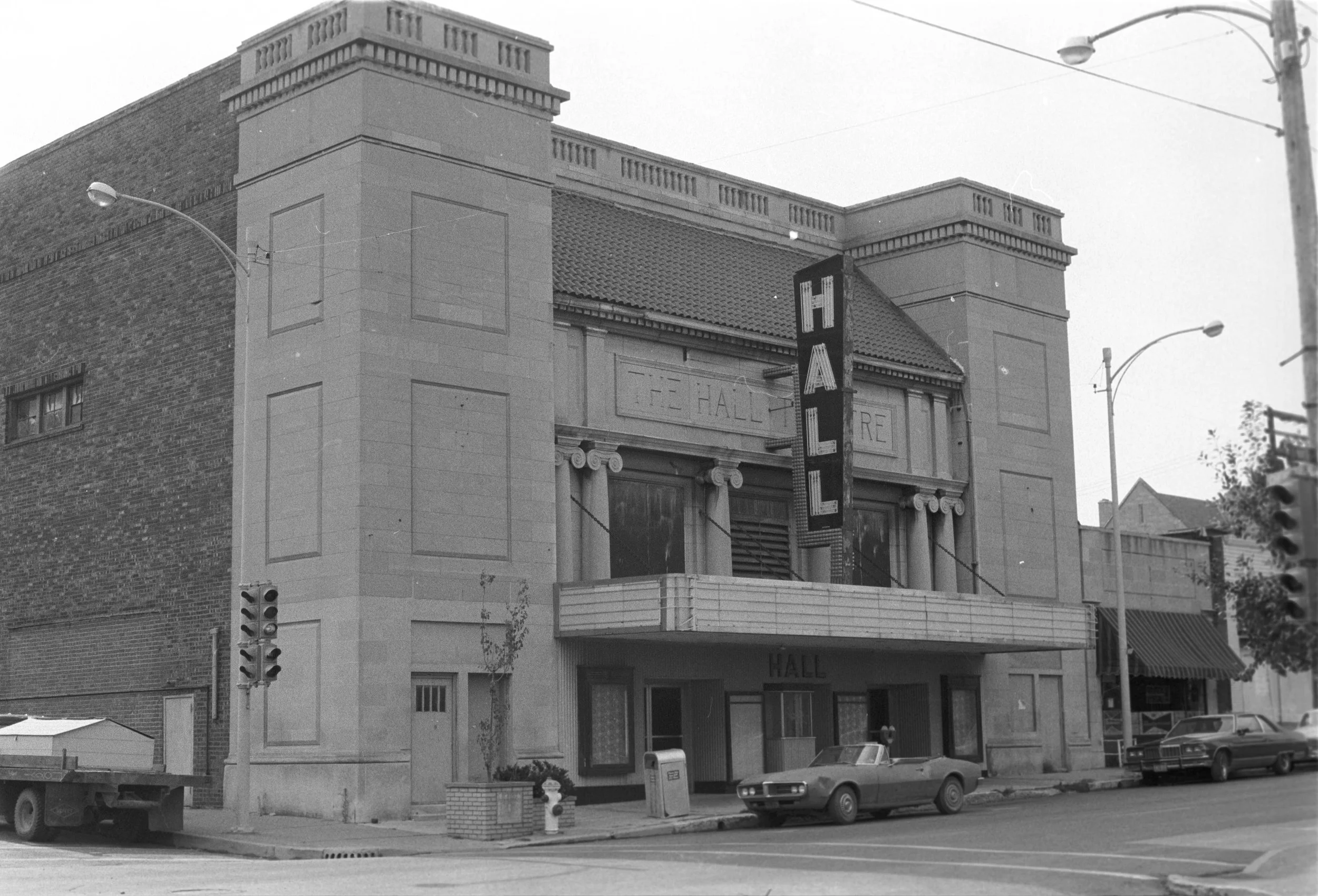
The Hall Theater (1915)
With a classical limestone facade bearing its name above 9th Street, The Hall Theater is an impressive building amongst the shops and sights of historic downtown Columbia, Missouri. Thomas C. Hall, a well-known businessman and theater operator, began its construction in 1915. To help him with this task, Hall contracted with the Boller Brothers, two influential brothers who were respected architects from Kansas City. The Boller Brothers, whose works eventually included nearly one hundred other theaters across the United States including the more famous Missouri Theatre, made quick work of the job. Thomas Hall paid for a majority of its construction with much of the material being locally sourced. Many companies, such as the Bowling Lumber Company, proudly promoted their work in establishing Columbia’s new theater in an August 27, 1916 issue of the The Daily Missourian, just prior to the Hall’s opening. The Hall’s exterior architecture takes inspiration from classical Greek and Roman buildings. This style, evident by the 6 Bedford limestone pillars at its entrance, was popular with the Boller Brothers and movie theaters in general. The theater’s interior was considered top of the line, with electric lighting and an impressive screen. The new feature most important to the patrons of the theater was its state of the art heating and cooling system. Cool air was blown over ice and through vents in the orchestra pit and under each seat, with hot air rising through windows in the top of the theater.
At its opening, The Hall offered 35 cent admission (roughly $10 in today’s money) to see orchestras, motion pictures, and vaudeville shows. During the 1920s, vaudeville started to take the backseat to the increasingly popular motion picture, which became the theater’s main attraction. The success of the hall led Thomas Hall to busy himself with building and opening two other theaters on 9th Street, the Missouri Theater and the Varsity Theater (today known as the Blue Note). In 1953, a tall lighted marquee was installed on the front of the building, allowing for easily visible promotions. Competition was increasing and a new entity had entered the Columbia Missouri theater scene; the Commonwealth Theatre chain leased the Missouri Theatre, and then The Hall Theater in 1955.
Under the lease of Commonwealth, The Hall Theater operated as a single screen movie theater and underwent two major renovations. The first, in 1967, reduced the seating from its original 1,300 to 725 and installed a moveable screen. However, change was on the horizon that would alter the fate of the Hall Theater and the movie palace craze altogether. With the introduction of the television in 1941, theater attendances began dropping. Sixty-five percent of Americans went to the movies weekly in 1936, but this dropped to 35 percent in 1950. In 1971, Commonwealth decided that a theater with only one screen does not draw the public as well as before. Due to the long term lack of profitability, Commonwealth closed The Hall Theater and stopped showing motion pictures there. Between 1971 and 1978, the Hall Theater became the venue where University of Missouri Opera classes performed their acts on its stage with the owners permission. After 1978 there were many attempts to restore or remodel the historic theater, but each attempt faltered. In 1987, Garry Lewis, a lawyer and real estate developer, purchased the theater with a plan to use the space as a dinner theater. During his renovation, workers removed two levels of false ceilings, uncovering the original woodwork. By 1989, the renovations had stalled and the property was sold to Max Gillard. Gillard continued the work of renovation with the hope of renting to a restaurant, St. Louis Bread Company, and his jewelry store, Bermuda Gold. During his remodel, Gillard stripped down the interior and removed the marquee. By 1993, the space hosted the jewelry store, which remained until the space was fully leased to the St. Louis Bread Company. Now known as Panera Bread, the restaurant was active at the location until it moved out in 2013. As of 2024, only 2,000 sq ft of the 7,000 sq ft building is occupied, with Shot Bar occupying a concrete box inside the original theater. Today the building is owned by Stan Kroenke and has remained vacant for over a decade.
Interesting Facts:
Even after its opening night, The Hall Theater was not fully complete, notably missing much of its interior paintwork. This was due to the closure of dye factories in Europe due to the First World War.
During this opening night performance, a 5 part war mystery drama was shown and 4 different vaudeville shows.
The Hall Theater is said to be haunted by the spirit of a loyal ticket salesman.
In 1928, the theater began showing motion pictures with sound when a Vitaphone was installed, including “The Jazz Singer” starring Al Jolsen.
CoMo Brick & Mortar is a creation of CoMo Preservation designed to raise awareness of Columbia's historic architecture.